About All Tours Hiking ToursClimbing ToursTrekking ToursPrivate ToursAnd Safari ToursNorthern Circuit Tours Directions Hours & Fees Guides
Find Tours 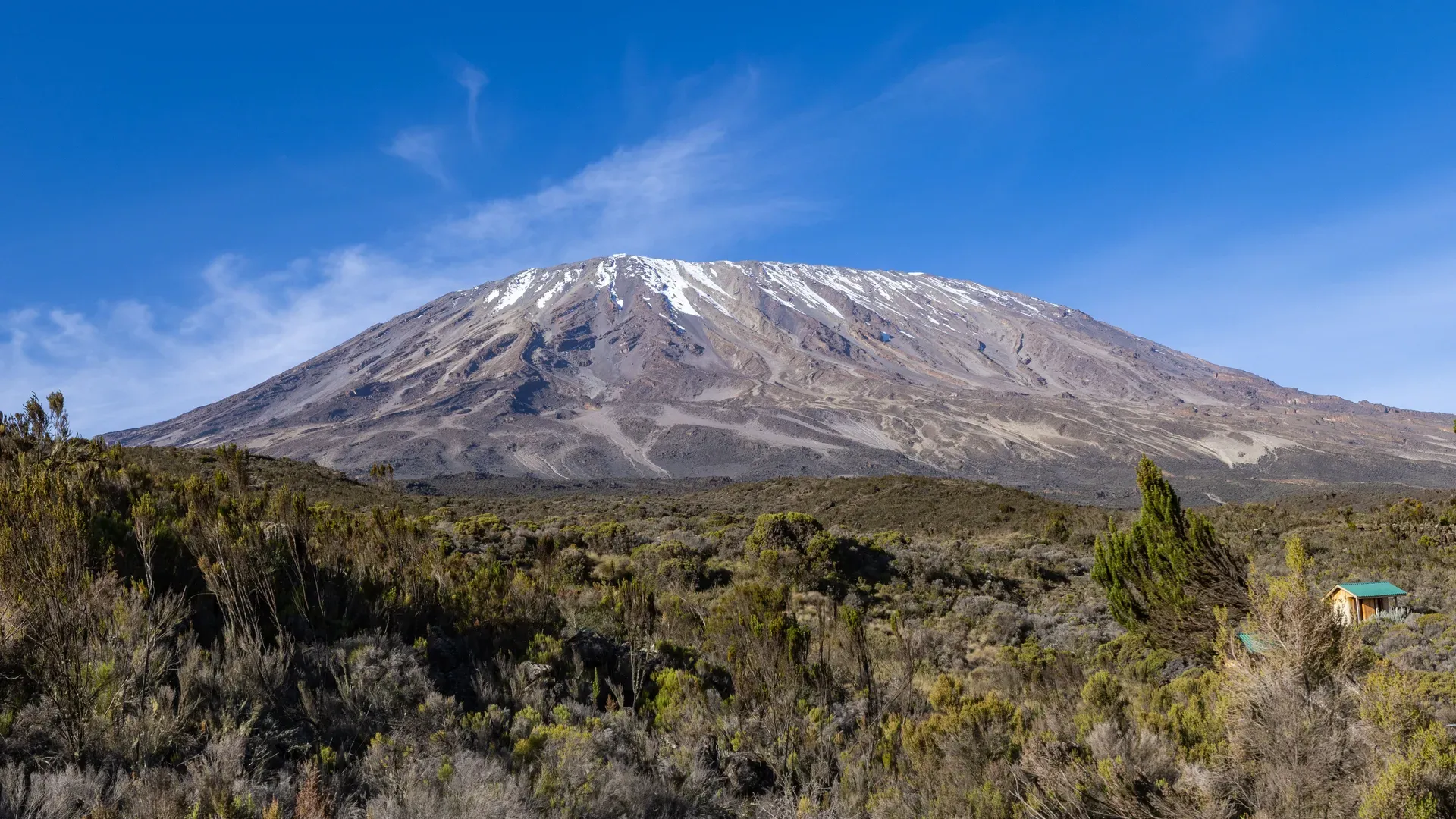
Mount Kilimanjaro is a dormant stratovolcano in northeastern Tanzania and the tallest freestanding mountain on Earth. It rises 5,895 meters above sea level, containing five distinct ecological zones from its tropical base to its glaciated summit.
Mount Kilimanjaro is a dormant stratovolcano in northeastern Tanzania and the highest peak in Africa. It reaches 5,895 meters at Uhuru Peak. Unlike most major mountains, it does not belong to a range. It's the world's tallest freestanding mountain, rising directly from the surrounding plains 300 kilometers south of the equator. The mountain anchors the 1,688-square-kilometer Kilimanjaro National Park. From the base town of Moshi, the park's six official entry gates are within a one to four-hour drive. Marangu and Machame gates sit about 45 minutes away on paved roads. The Lemosho and Londorossi gates require a three-hour drive, partly on unpaved 4x4 tracks.
Trekkers walk through five distinct ecological zones to reach the top. The base starts in cultivated bushland at roughly 1,800 meters, where temperatures hover around 30 degrees Celsius. The trail then enters a dense rainforest canopy. Here, old man's beard moss hangs from the branches while colobus and blue monkeys move overhead. Above the treeline at 2,800 meters, the landscape shifts to heath and moorland. The alpine desert takes over at 4,000 meters—a barren expanse of volcanic rock subjected to intense solar radiation and sub-zero nights. The final push crosses an arctic summit zone containing the remnants of the Furtwängler Glacier.
Visitors attempt the summit on multi-day treks ranging from five to ten days. The climb requires no ropes or technical mountaineering skills. Success depends entirely on physical endurance and altitude acclimatization. Climbers choose from several established paths. The Marangu Route offers solar-lit wooden dormitories like Mandara and Horombo Huts. The Machame and Lemosho routes require canvas tents and feature the Barranco Wall, a 260-meter rock scramble. The Northern Circuit loops around the quiet eastern slopes near the Kenyan border for nine or ten days. Families with teenagers should look at the Marangu path; serious hikers prefer the Lemosho route.
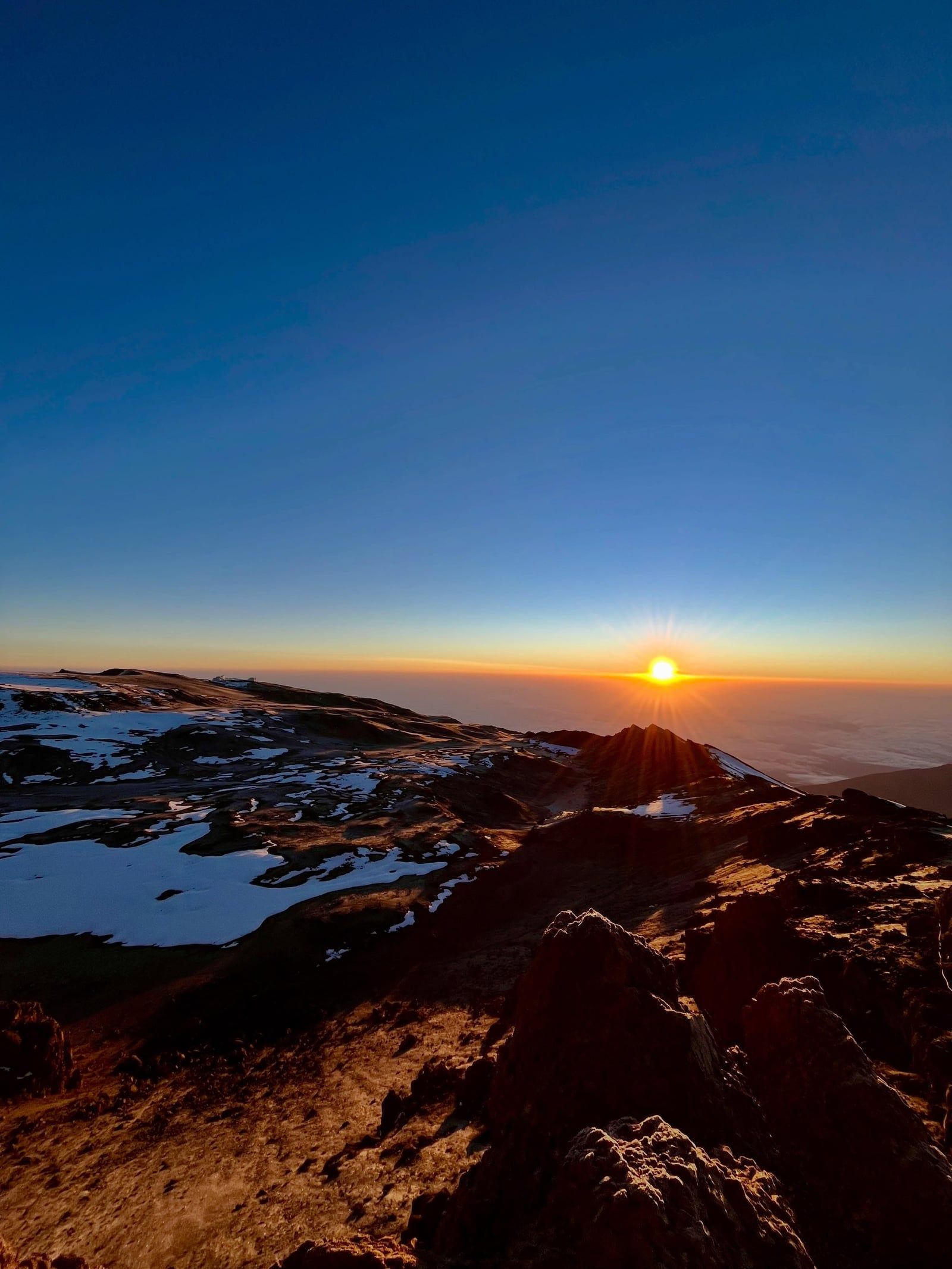
Acute Mountain Sickness affects over 75 percent of trekkers to some degree. Climbers must watch for persistent headaches and nausea. Severe symptoms require immediate descent. At the top, climbers reach the crater rim at Gilman's Point or Stella Point before walking the final stretch to Uhuru Peak. Most teams climb through the night from high camps like Barafu or Kibo to catch the sunrise over the cloud inversion. The trek ends at Mweka Gate. Returning climbers gather at this lower ranger post to receive official summit certificates.
Local Chagga communities farmed the fertile lower slopes of Kilimanjaro for centuries before European contact. They utilized the mountain's constant runoff to irrigate banana and coffee crops. Missionary-explorer Johannes Rebmann recorded the first European sighting of the mountain in 1848. His reports of a snow-capped peak near the equator met heavy skepticism in the Royal Geographical Society in London. Count Samuel Teleki mounted the first serious European expedition in 1887. He reached the snowline but turned back due to altitude sickness and inadequate cold-weather equipment.
German geographer Hans Meyer and Austrian mountaineer Ludwig Purtscheller achieved the first recorded ascent of Kibo's summit on October 6, 1889. They hired a local guide, Yohani Kinyala Lauwo, and established a series of high camps to acclimatize. Meyer had failed on two previous attempts. On this third expedition, the team used ice axes to cut steps into the crater's glaciers. These ice fields were vastly larger than they are today, covering much of the upper cone.
The British colonial government designated the mountain a forest reserve in 1921 to protect the watershed. Tanzania reclassified the core mountain area above the treeline as a National Park in 1973. It opened to public access in 1977. UNESCO inscribed Kilimanjaro National Park as a World Heritage Site in 1987. The committee cited its five altitudinal ecosystems and its status as a superlative natural phenomenon.
Today, the park enforces strict regulations to manage the tens of thousands of climbers who arrive annually. Independent climbing is illegal. Trekkers must hire licensed Tanzanian operators. Climbers register with their passports at official gates like Machame or Lemosho before starting. Park rangers weigh all porter loads at these gates to ensure they do not exceed the 20-kilogram legal limit. Daily check-ins and logbook signing at each camp are mandatory for safety tracking. The park authority strictly controls media production. Professional filming requires permits costing up to $3,000 per day. Unauthorized drone flights are illegal without dual permits from TANAPA and the Tanzania Civil Aviation Authority. Leave your drone at home to avoid confiscation and heavy fines.
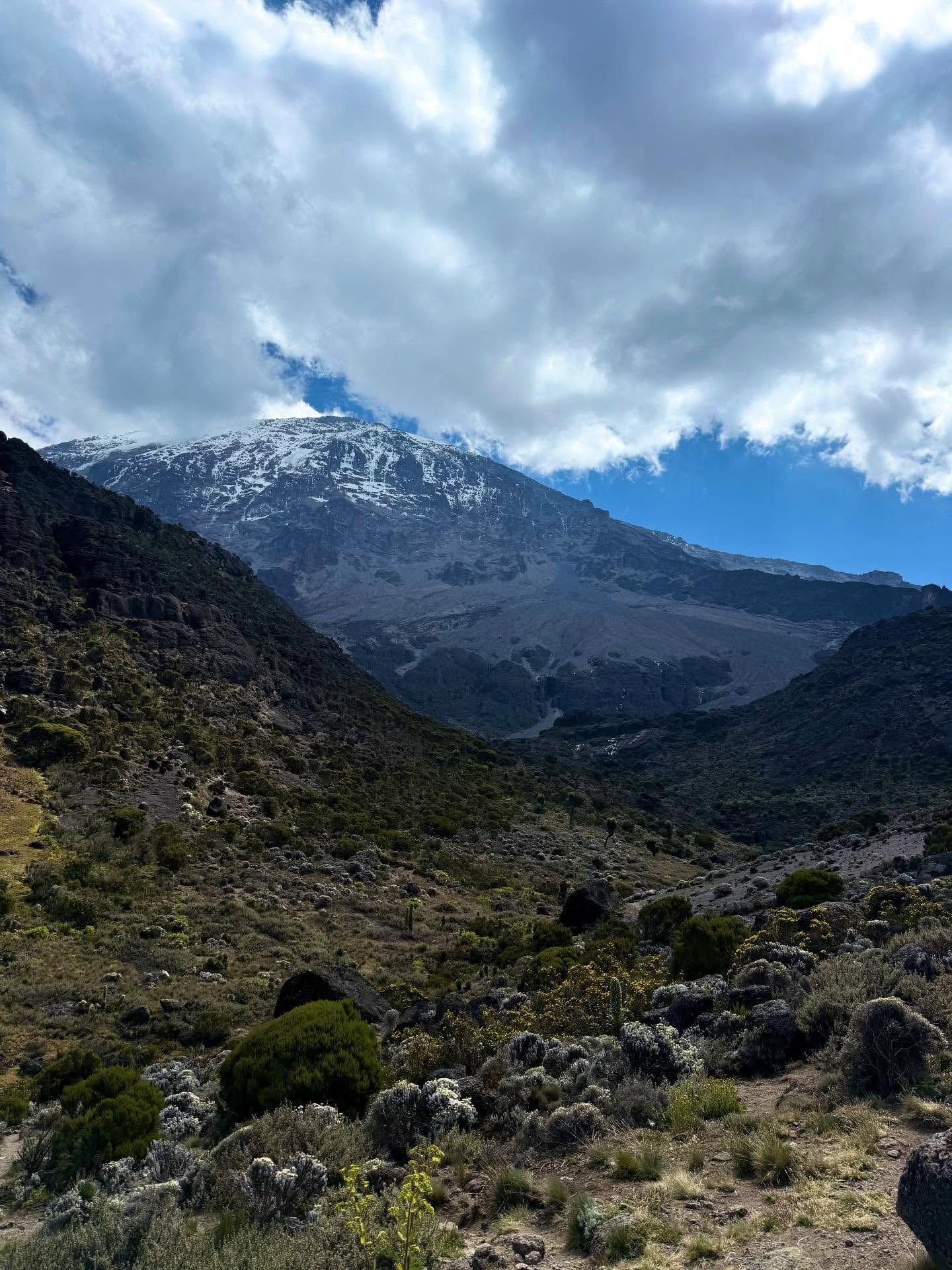
Kilimanjaro is a massive stratovolcano composed of three distinct volcanic cones: Kibo, Mawenzi, and Shira. Shira is the oldest and shortest cone. It collapsed roughly half a million years ago, leaving a broad, flat caldera floor at 3,800 meters. Climbers on the Lemosho Route cross this vast Shira Plateau, walking past eland tracks and wide-open moorland views. Mawenzi is a jagged, heavily eroded peak on the eastern side, connected to Kibo by a massive alpine saddle. Kibo is the highest and youngest cone. It retains a dormant central crater and hosts Uhuru Peak at 5,895 meters. Kibo's last major eruption occurred 360,000 years ago, though fumaroles in the crater still emit sulfurous gas.
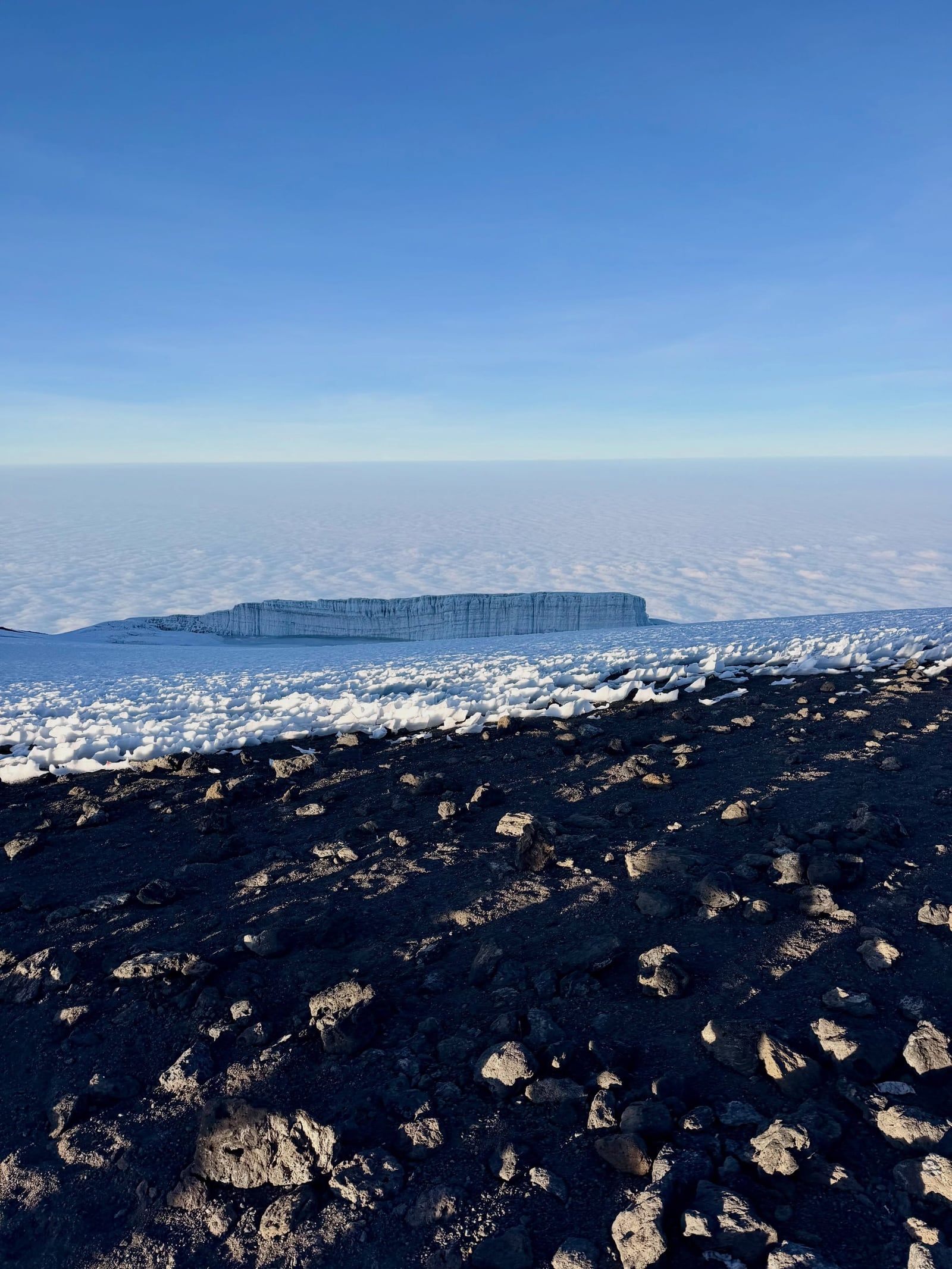
The Barranco Wall sits on the southern circuit, intersected by the Machame and Lemosho routes. It's a 260-meter near-vertical rock face. Trekkers ascend it hand-over-hand in about one to two hours. It offers a non-technical climbing challenge with sweeping views back over the Barranco Valley. Higher up, the summit zone transitions into an arctic environment. Temperatures drop to -20 degrees Celsius or colder. The Furtwängler Glacier and the Northern Ice Field sit near the crater rim. These ice caps have retreated drastically over the last century due to climate change. Current geological surveys indicate the remaining ice could disappear entirely within the next few decades.
The mountain's sheer scale creates its own localized weather system. From the upper slopes, climbers can see Mount Meru in Arusha National Park rising to the west. On clear days, the view stretches south across the Kenyan border into Amboseli National Park. The dry seasons from January to early March and June to October offer the most stable weather and highest summit success rates. April and May bring the long rainy season. During these months, summit success rates drop by 20 to 30 percent due to muddy trails and low visibility. Skip the trek in April. The rapid weather changes require climbers to carry waterproof layers and insulated jackets at all times. Guides frequently adjust the daily pace or delay pre-dawn summit attempts if severe storms hit the upper slopes.
The Chagga people have inhabited Kilimanjaro's foothills for generations. They call the mountain "Kipoo" (Kibo) and "Kimawenzi" (Mawenzi). Traditional Chagga belief systems position the mountain as a sacred entity and the seat of Ruwa, their supreme deity. Historical burial practices involved facing the deceased toward the peak. The mountain's continuous glacial meltwater feeds a complex network of traditional irrigation channels. These channels sustain the Chagga's agricultural livelihood on the lower slopes, where coffee and bananas dominate the cultivated bushland.
The name "Kilimanjaro" has disputed origins. Some linguists suggest it combines the Swahili word "Kilima" (mountain) with the Chagga word "Njaro" (whiteness). Others argue it means "Mountain of Caravans." This refers to its historical use as a massive navigational landmark for Arab and Swahili trading routes moving inland from the East African coast. Today, the mountain drives the local economy of the Kilimanjaro Region. Moshi, located 45 kilometers from Kilimanjaro International Airport, revolves around the trekking industry. Thousands of local residents work as guides, cooks, and porters. The Kilimanjaro Porters Assistance Project (KPAP) monitors these expeditions. They enforce fair wages, adequate food, and proper cold-weather gear for the crew. Always book with a KPAP-approved operator.
Trekking culture on the mountain has developed its own set of modern traditions. Alcohol is strongly discouraged above 3,000 meters due to dehydration and altitude risks. Instead, climbers and crew bond over hot tea and high-calorie meals in the mess tents. At the end of a trek, groups hold tipping ceremonies at the final camp or gate. Operators encourage these collective exchanges rather than individual handouts to ensure fair distribution among the entire support team. Children under five pay no conservation fees, though the park enforces a strict minimum climbing age of 10 years old. Elderly trekkers in their seventies and eighties frequently attempt the peak. If you're over 60, book an eight or nine-day itinerary to give your body time to adjust to the thin air.
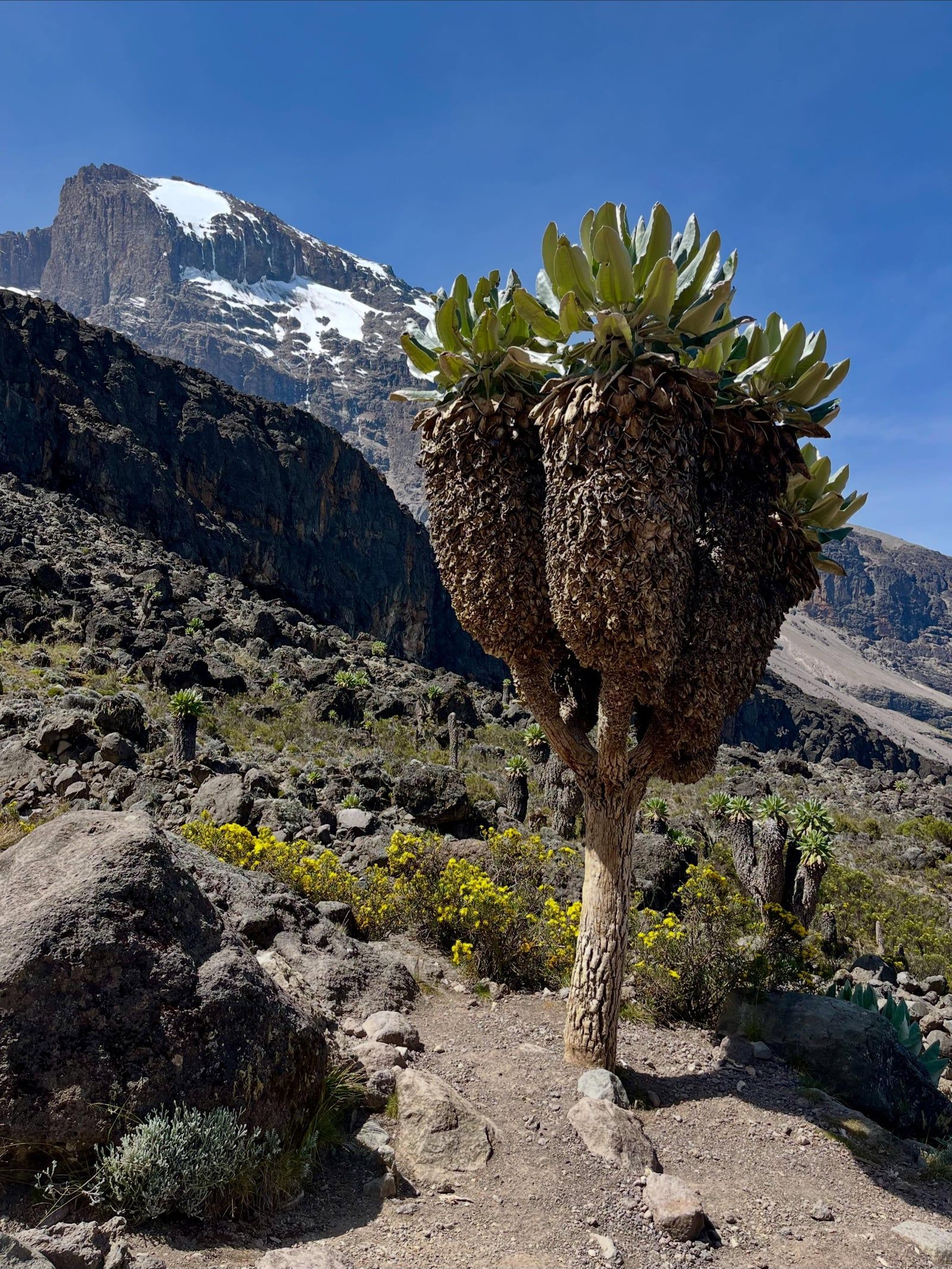
Kibo is a dormant volcanic cone, and its crater still contains active fumaroles emitting sulfurous gas.
Kilimanjaro's ice cap has shrunk by over 80% since 1912, and the remaining glaciers may disappear completely in the coming decades.
Climbers using specialized all-terrain wheelchairs have successfully reached the summit via the Marangu Route with large support teams.
Trekkers on the Machame and Lemosho routes must scramble up a 260-meter near-vertical rock face known as the Barranco Wall.
The Marangu Route is the only path on the mountain equipped with solar-lit wooden dormitories instead of canvas tents.
Kilimanjaro SAR operates high-altitude helicopter evacuations from specific landing pads on the mountain for climbers suffering from severe altitude sickness.
Park rangers weigh every porter's bag at the entry gates to ensure no one carries more than the legal maximum of 20 kilograms.
Park fees for a 7-day trek total around $900 to $1,200 per climber. This includes a $70 daily conservation fee, a $50 nightly camping fee, and a $20 rescue fee. The total trip cost with a tour operator usually ranges from $2,000 to $4,000.
Yes. The Tanzania National Parks Authority requires all climbers to book through a licensed Tanzanian tour operator. Independent or unguided climbing is strictly prohibited.
Treks range from five to ten days depending on the route. Most climbers choose a six to eight-day itinerary. Longer treks provide better altitude acclimatization and yield much higher summit success rates.
Success rates vary heavily by route duration. Short five-day routes have success rates as low as 27 to 45 percent. Longer routes lasting seven to nine days generally see success rates of 85 percent or higher.
The official minimum age is 10 years old. Park rangers enforce this rule at all entry gates. Climbers under 16 typically need written parental or guardian consent.
The dry seasons from January to early March and June to October offer the best conditions. July and August provide the clearest skies and minimal rainfall. April and May bring heavy rains, muddy trails, and low visibility.
Uhuru Peak, the highest point on Mount Kilimanjaro, stands at 5,895 meters (19,341 feet) above sea level. It is the tallest mountain in Africa and the highest freestanding mountain in the world.
No. Kilimanjaro is a non-technical trek that requires no ropes, crampons, or specialized mountaineering skills. The only exception is the Barranco Wall, which requires a brief hand-over-hand rock scramble.
Yes. Wheelchair users have summited the mountain, typically using the Marangu Route. This requires an all-terrain wheelchair and a large, experienced support crew to navigate the rough volcanic terrain.
The fees cover a $70 daily entry fee, a $50 nightly camping fee (or $60 for huts), and a one-time $20 rescue fee. The government also adds an 18 percent VAT to most charges. Tour operators collect these fees in advance and pay them directly to the park authority.
Browse verified tours with free cancellation and instant confirmation.
Find Tours